
The Invisible Giant: Global Dynamics of Aquifer Recharge by Precipitation
-
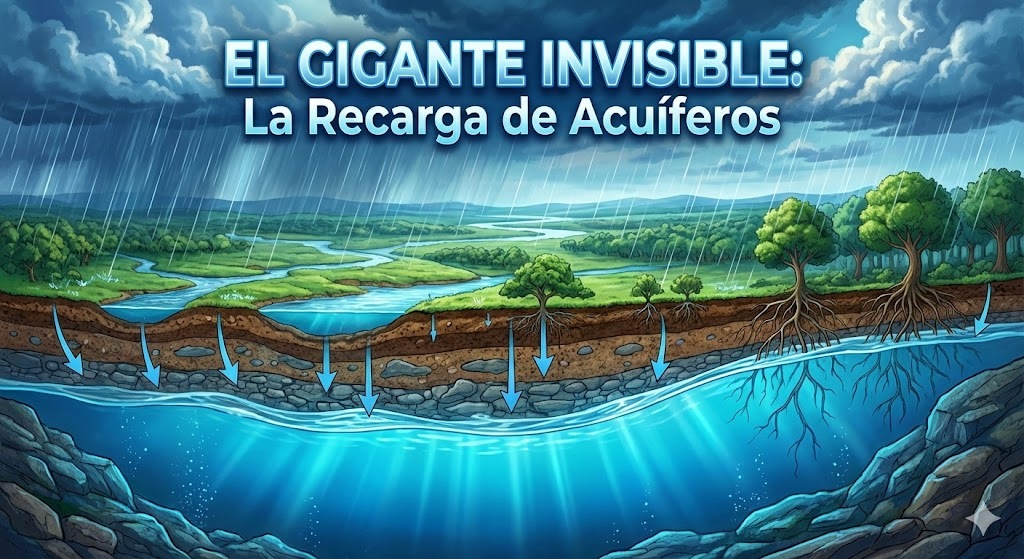
Although rivers and lakes often capture our attention, the largest reserve of liquid freshwater on the planet is not visible. Ninety-nine percent of the Earth’s liquid freshwater is found beneath our feet, in aquifers. However, this vital resource is neither infinite nor static; its survival depends on a critical and complex process: recharge.
-
In this article, we will explore how precipitation interacts with geology, climate, and human activity to feed our underground reserves and why climate change is altering the rules of the game on a global scale.
The Groundwater Cycle: From Cloud to Aquifer
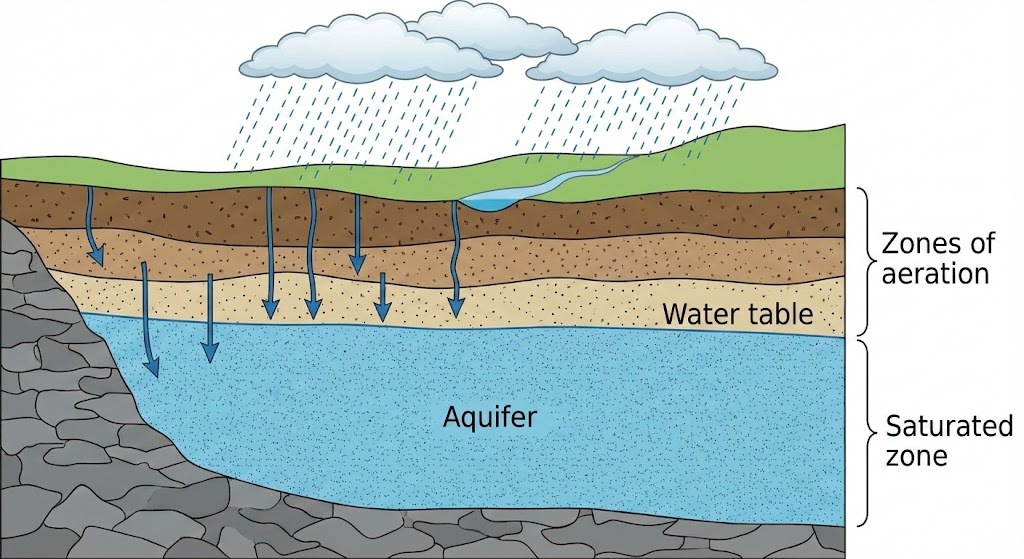
Aquifer recharge is the process by which water moves down from the Earth’s surface to the saturated zone of the soil. Although rain is the main source, not every drop of water that falls from the sky reaches the aquifer. Precipitation’s fate is divided into three paths:
- Evapotranspiration: Water that evaporates directly or is absorbed and transpired by plants.
- Surface runoff: Water that flows over the ground into rivers and seas.
- Infiltration: Water that penetrates the soil and eventually reaches the deeper layers.
The concept of “Net Recharge”
To understand the water balance, hydrogeologists use the following simplified relationship:
R = P – (ET + RO)
Where R is recharge, P is precipitation, ET is evapotranspiration, and RO is runoff. This equation reveals that even in areas with high precipitation, recharge can be low if temperatures are extreme or the terrain is impermeable.
Factors that Determine Recharge Efficiency
Not all rainfall is equal for an aquifer. Recharge efficiency depends on a triad of factors: intensity, geology, and vegetation.
Intensity vs. Duration
There is a paradox in modern hydrology: more rain does not always mean more groundwater. * Moderate, persistent rainfall: This is ideal. It allows the soil to absorb water gradually, giving it time to filter down.
- Extreme storms: These often exceed the soil’s infiltration capacity. The result is massive runoff that causes flooding rather than recharging the aquifer.
The Nature of the Terrain
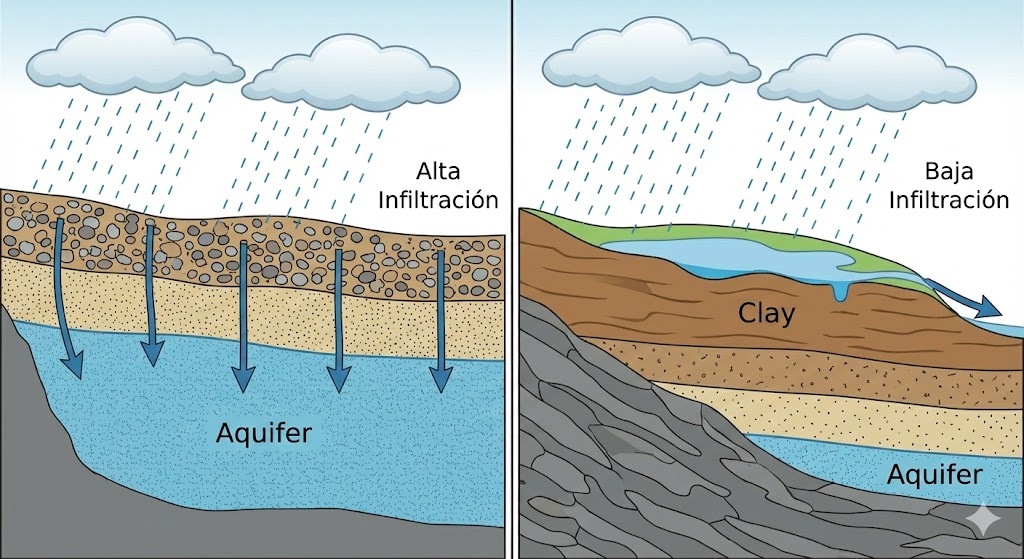
The porosity and permeability of rocks and soils dictate the speed of water travel.
| Soil/Rock Type | Infiltration Capacity | Recharge Rate |
| Sand and Gravel | Very High | Days or weeks |
| Clay Soils | Very Low | Years or decades |
| Limestone rocks (karst) | Very high (due to fractures) | Hours or days |
| Granites | Almost none | Only through faults |
The Impact of Climate Change: A Future of Extremes
By 2026, climate models have confirmed that the hydrological cycle is “accelerating.” This has direct implications for the availability of groundwater worldwide.
Precipitation Variability
Climate change not only alters how much it rains, but also how it rains. In regions such as the Mediterranean and the southwestern United States, we are seeing longer periods of drought followed by torrential rainfall events. This reduces effective recharge, as dry soil becomes hydrophobic (repels water) and heavy rains are lost to runoff.
Rising Temperatures
As global temperatures rise, so does evapotranspiration. This means that a greater proportion of rainfall returns to the atmosphere before it has a chance to infiltrate. In arid regions, this can reduce annual recharge by up to 20%, even if total precipitation remains constant.
The Human Footprint: Soil Sealing and Deforestation
Urbanization is one of the greatest enemies of aquifer recharge. By covering the land with asphalt and concrete, we create impervious surfaces that prevent water from passing through.
- Effect of cities: In a natural watershed, 50% of rainfall could infiltrate. In a dense city, that number can fall below 10%.
- Deforestation: Forests act like a “sponge.” Their roots create channels in the soil and their shade reduces evaporation. When forests are cleared for agriculture, the soil becomes compacted, drastically reducing recharge.
Key Fact: It is estimated that excessive pumping of aquifers for irrigation has caused sea levels to rise by more than 1 mm per year, as the extracted water eventually ends up in the oceans.
Management and Solutions: Managed Aquifer Recharge (MAR)
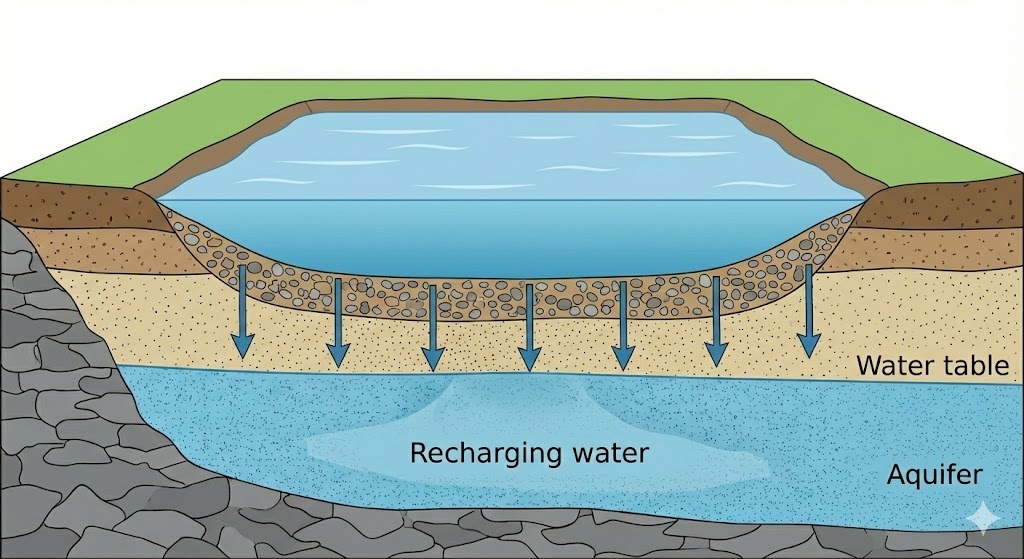
Faced with the crisis of scarcity, humanity has gone from being a passive observer to an active manager. Managed Aquifer Recharge (MAR) is a set of techniques designed to inject or infiltrate water into the subsoil during periods of abundance (rainfall) for use in periods of scarcity.
Main Methods:
- Infiltration ponds: Artificial lagoons where rainwater is stored so that it can slowly filter through.
- Injection wells: Direct injection of treated water into the aquifer.
- Water seeding: Ancestral techniques (such as “Acequias de Careo” in Spain or “Amunas” in Peru) that divert water from rivers to areas of high permeability in the mountains.
Global Overview: Critical Areas
The situation of aquifers varies dramatically depending on geography:
- Guaraní Aquifer (South America): One of the largest in the world. It enjoys generous recharge due to tropical rains, but faces risks from agricultural pollution.
- Nubian Aquifer System (Africa): This is a “fossil water” aquifer. It receives almost no current recharge because it is located under the Sahara; once it is depleted, it will not recover in human timescales.
- Indus-Ganges Basin (India/Pakistan): This is the region with the highest extraction in the world. Despite the monsoons, consumption exceeds natural recharge, causing an alarming decline in water tables.
The Future Under Our Feet
The relationship between rainfall and aquifer recharge is more fragile than it seems. It is not enough to wait for rain; we need to protect recharge areas, reduce soil sealing, and adapt our infrastructure to capture water from the intense storms that climate change brings.
Groundwater management is the defining challenge for food and human security in the 21st century. Without healthy recharge, the “invisible giant” could eventually disappear, leaving us without our most important insurance policy against drought.